




Most homeowners in Melbourne's west end up paying about $1,500 to over $4,000 to supply and install a standard instant gas hot water system. The gap is wide because the unit itself might sit around AUD 700 to AUD 1,500 for the appliance alone, but the final bill changes fast once gas line work, flueing, access, removal, and compliance are added.
If you're reading this after a cold shower in Caroline Springs, you probably don't care about brochure language. You want to know one thing. What will it cost to get hot water back on today, and why does one quote look nothing like the next?
That confusion usually starts with the wrong number. People search for instant gas hot water system prices, see a unit advertised online, and assume that's close to the whole job. It usually isn't. In real plumbing work across Melbourne's western suburbs, the sticker price is only one part of the spend. The installed cost is what matters.
Table of Contents
- Why Instant Hot Water Prices Are So Confusing
- Breaking Down the Unit Price What You Get for Your Money
- The Real Cost Factors Installation and Compliance
- Solving a Cold Shower Crisis Same Day Changeovers and Financing
- Calculating the Lifetime Cost Running and Maintenance Expenses
- How to Get an Accurate Quote from Total Plumbing
- Your Pre-Call Checklist Questions to Ask Any Plumber
Why Instant Hot Water Prices Are So Confusing
The usual sequence goes like this. The old water heater fails overnight. Someone in the house gets a cold shower, then starts searching prices on their phone before breakfast.
The first numbers they see are often product listings. That's where the trouble starts. Public retail listings can show anything from A$381.54 for a basic natural gas tankless unit to A$1,945 for a Bosch instantaneous model on this retail pricing page for natural gas tankless water heaters. Those numbers tell you the box price, not the full job cost.
In a home around Caroline Springs, Taylors Hill, Deer Park, or Point Cook, the plumber still has to answer the hard questions. Is it a like-for-like swap, or are you changing from storage to continuous flow? Is the existing gas line sized correctly? Does the new unit need different flueing? Can the old system come out cleanly, or is access tight?
Practical rule: If the advertised price doesn't mention removal, gas fitting, flueing, and compliance, it isn't your final price.
That's why two neighbours can buy similar units and end up with very different invoices. One house might only need a straightforward changeover on an outside wall. Another might need line upgrades, extra fittings, wall work, or relocation because the old setup no longer suits the new appliance.
The sticker price is not the installed price
A lot of online guides stop at “unit costs”. That's useful if you're comparing brands on a shelf. It's not enough if you need hot water restored safely and legally.
The number that matters is total installed cost. That includes the heater, labour, parts, safe disconnection of the old unit, commissioning, and whatever is needed to bring the job up to current standards. In the western suburbs, older homes and quick builder-grade original installs can make that gap larger than people expect.
Why homeowners get caught out
The cheapest visible unit is often not the cheapest outcome.
A low appliance price can still turn into an expensive job if the installer has to:
- Resize gas pipework because the new continuous-flow unit draws differently from the old system
- Add or alter flueing to suit the appliance and location
- Fix access issues where the unit sits behind screens, in narrow side passages, or under awkward clearances
- Remove and dispose of the old heater safely
That's why instant gas hot water system prices seem all over the place. People are comparing a product listing with a complete plumbing job, and those aren't the same thing.
Breaking Down the Unit Price What You Get for Your Money
For the appliance alone, instantaneous gas hot water systems in Australia are typically around AUD 700 to AUD 1,500, with the upper end usually tied to higher flow-rate models and higher star ratings, as noted by ELGAS in its guide to gas instantaneous hot water unit prices.
That range is a good starting point, but it only makes sense if you know what changes the number.
Flow rate decides how the system copes under pressure
Flow rate is about demand. In plain terms, it's the difference between a unit that comfortably handles normal household use and one that starts struggling when two taps and a shower run close together.
A lot of homeowners buy too small because they focus on the cheapest sticker. That usually backfires. If the house has multiple bathrooms, a growing family, or regular back-to-back showers, undersizing saves money on day one and causes complaints for years.
Consider the difference between buying a ute for the school run and buying one for a tradie who loads it every day. They're both utes, but the workload matters.
Star rating affects long-term value
The higher-priced units often carry stronger efficiency credentials. That doesn't automatically mean you should buy the most expensive model on the wall, but it does mean the price difference usually reflects more than branding.
A better-rated unit can make sense if the household uses plenty of hot water and plans to stay in the property. A cheaper model can still be the right call for a smaller home, a rental, or a like-for-like replacement where budget is tight and demand is modest.
Don't choose the cheapest unit first. Choose the right size first, then compare brands inside that size.
Brand, parts support, and warranty all matter
Plumbers and homeowners sometimes look at the same product differently. Homeowners often compare purchase price. Plumbers also think about spare parts, support, controller options, warranty process, and whether the unit has a solid service network.
That's why names like Rinnai, Bosch, and Rheem stay in the conversation. Not because every job needs the premium option, but because after installation, reliability and support become part of the value.
If you're comparing systems for your home, it helps to look at available hot water system services in Melbourne's west before picking a unit in isolation. The right heater is the one that suits your property, your demand, and your budget once installation is factored in, not just the one with the lowest shelf price.
The Real Cost Factors Installation and Compliance
The unit gets attention because it's easy to compare. Installation is where differences show up.
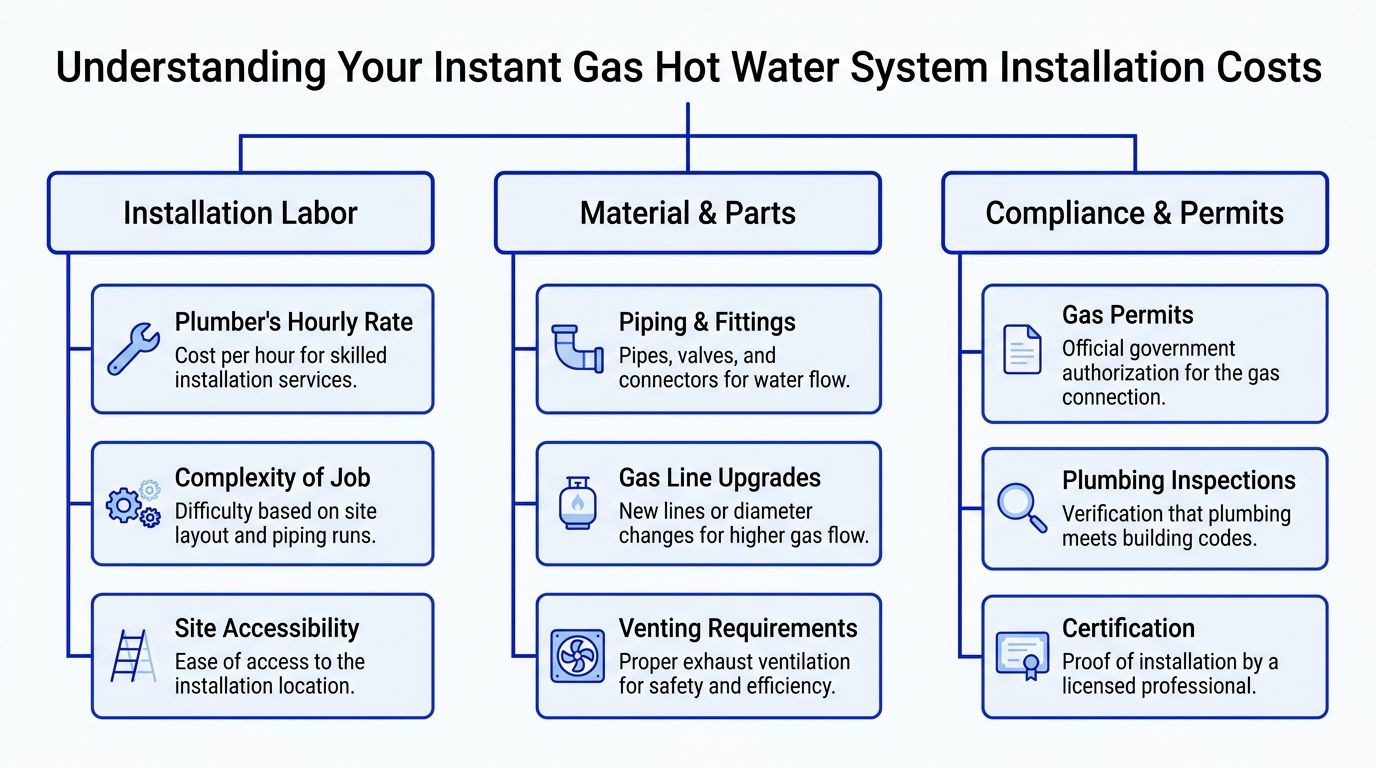
Government assessments use a baseline unit cost of $850 for an instantaneous gas water heater, but they also recognise upper unit-cost cases of $2,500 depending on model and setup in the draft Water Heater Technology Economic Assessment. That same assessment is useful because it reflects a point plumbers see every week. Once setup gets complicated, the neat “unit price” idea falls apart.
Why the same unit can produce very different quotes
A standard external changeover is one type of job. A conversion from an old storage heater to a new continuous-flow system is another.
In practice, the quote moves around because of site conditions. One property has clean access, suitable pipe sizing, and a compliant location. Another has tight access, older pipework, limited wall space, or a gas line that won't support the new unit properly without extra work.
A proper installer also has to consider safe commissioning, legal gas work, and whether the installation location suits the appliance manufacturer's requirements. That's not fluff. That's the difference between a heater that just turns on and a heater that's installed properly.
What usually appears on a proper installation quote
Here's the sort of cost structure homeowners should expect to see explained.
| Factor | Description | Potential Cost Impact |
|---|---|---|
| Unit supply | The appliance itself, with price varying by model, flow rate, and efficiency | Lower for basic units, higher for premium or larger-capacity units |
| Labour | Time to disconnect, install, test, and commission the system | Higher when access is poor or changeover is complex |
| Gas line upgrades | Additional gas fitting work if existing pipework isn't suitable | Can add materially to the final quote |
| Flueing or venting | Required where the unit or location needs compliant exhaust management | Can increase parts and labour cost |
| Pipework and fittings | Water connections, valves, brackets, and adjustment work | Varies by how much needs changing |
| Old unit removal | Safe disconnection and disposal of the existing system | Often included, but not always |
| Compliance paperwork | Required licensed gas and plumbing compliance steps | Essential, not optional |
If gas pipework needs work, that should be handled by a licensed provider offering gas fitting and gas line services. That line item is often one of the least understood parts of the whole quote, but it can be one of the most important.
A cheap quote that ignores gas upgrades, flue requirements, or compliance isn't a bargain. It's an incomplete quote.
This short explainer shows the sort of installation issues that can affect the final job:
Compliance is not a nice-to-have
In Victoria, gas hot water work needs to be carried out properly and documented properly. Homeowners sometimes treat compliance as paperwork. It isn't. It's part of the job.
A compliant install protects the occupants, the property owner, and anyone managing the property. It also matters later if there's a warranty issue, sale, insurance question, or future repair. If a quote is vague on certification, old unit removal, or what exactly is included, ask for that in writing before approving the work.
Solving a Cold Shower Crisis Same Day Changeovers and Financing
Hot water replacement isn't always a calm, researched purchase. Most of the time it's urgent. The system fails, the family still needs showers, and the property manager wants it sorted now.
That urgency changes the buying decision. In a perfect world, you'd spend days comparing models, reading manuals, and lining up several inspections. In reality, households often need a practical option that gets hot water back the same day, provided the job conditions allow it.
When speed matters more than shopping around
A same-day changeover makes the most sense when:
- The old unit has failed completely and the home can't function without hot water
- The replacement path is straightforward such as a similar unit in a suitable location
- The household has no tolerance for delay because of kids, elderly occupants, tenants, or business use
In those situations, the best decision usually isn't the one with the lowest theoretical price. It's the one that restores service safely without turning a one-day problem into a week-long disruption.
When finance makes sense
Not every hot water failure arrives at a good time for the household budget. That's where payment flexibility can be useful. Some plumbing businesses, including access to interest-free payment options for plumbing work, offer a way to approve the right installation now and spread the cost rather than settling for the wrong unit just because it has the lowest upfront spend.
This isn't about buying extras you don't need. It's about separating must-haves from nice-to-haves.
Must-haves usually include:
- A correctly sized unit
- Safe gas work
- Any required compliance items
- Reliable installation that restores hot water properly
Nice-to-haves may include upgraded controllers, premium features, or stepping up to a higher model when a more basic one would already meet the household's demand.
If the system has failed suddenly, same-day supply and installation can be the sensible move. If the budget is tight, finance can keep the decision practical instead of rushed.
Calculating the Lifetime Cost Running and Maintenance Expenses
Upfront price matters. Ongoing cost decides whether the system still feels like a smart purchase a few years later.
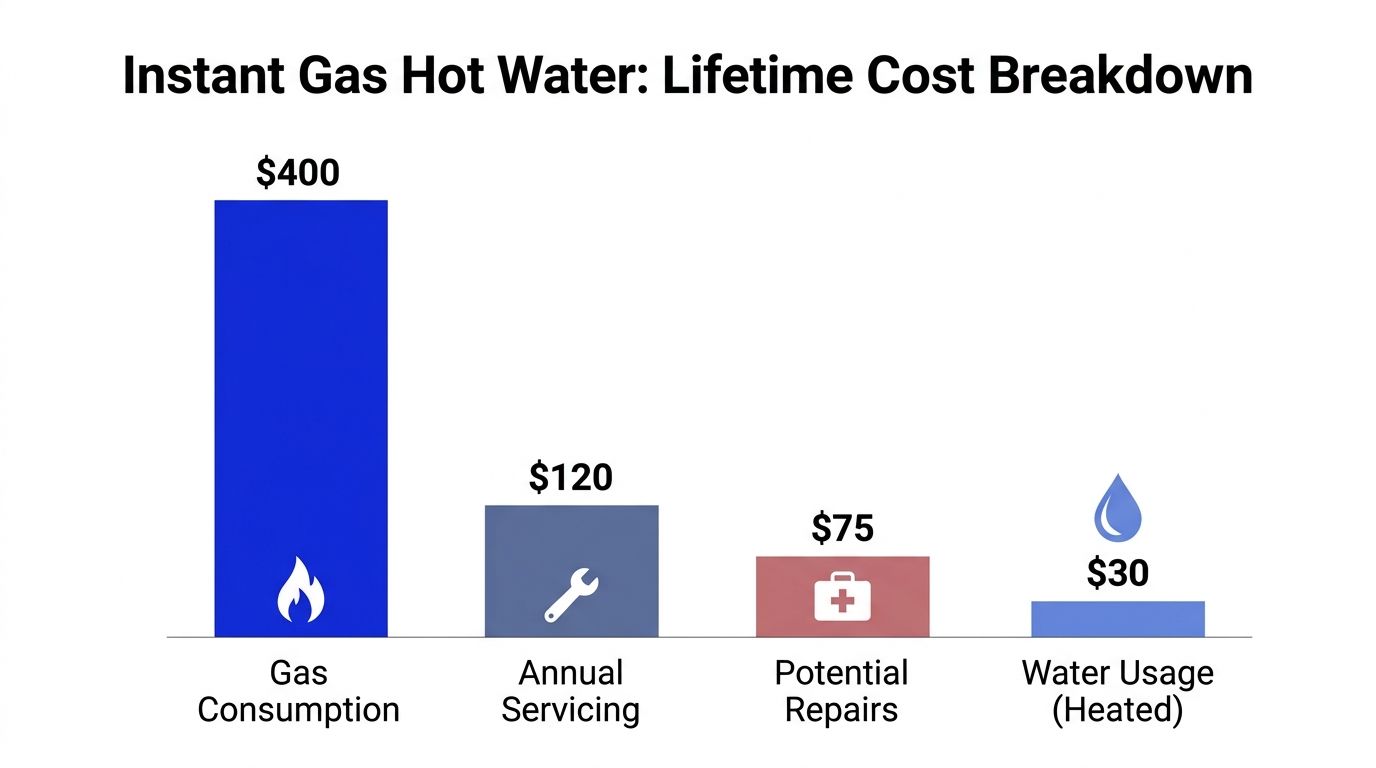
That's where fuel type becomes a major part of the conversation. For a 5-star gas instantaneous system, running cost data shows about AUD 253.68 per year on natural gas, while the LPG version comes in at about AUD 1,297.07 annually in the SA water heater running cost comparison factsheet.
Fuel type changes the maths
That gap is the sort of detail many buyers miss when they focus only on purchase price. If your property has natural gas available, an instantaneous gas unit can look very sensible over time. If the home relies on LPG, the running-cost picture changes sharply.
For homeowners in Melbourne's west, that means the better question isn't just “How much is the heater?” It's “What fuel will this system run on, and what will that mean over the life of the unit?”
The wrong fuel setup can wipe out the savings people expect from moving to continuous flow.
This is also where efficiency matters in a practical way. A stronger star rating won't rescue a poor installation decision, but when two suitable units are close contenders, better efficiency can help shift the long-term value.
Maintenance is part of ownership
Instant systems are generally straightforward, but they're not maintenance-free. Burners, filters, valves, controllers, and water quality all affect long-term performance.
A few practical points matter:
- Annual attention helps catch problems early before a minor fault becomes a no-hot-water breakdown
- Hard water and debris can shorten component life if the system isn't checked
- Neglected units often fail at the worst time, which usually means an urgent call-out rather than a planned repair
Some households won't need much beyond normal servicing and the occasional repair. Others, especially in older properties with mixed-condition plumbing, may face more ongoing attention. That's one reason the cheapest installation on day one isn't always the cheapest ownership path.
If you're comparing options, look at the heater as a package made up of purchase, installation, fuel, and upkeep. That's the only fair way to judge value.
How to Get an Accurate Quote from Total Plumbing
The fastest way to get a useful quote is to stop thinking like a shopper and start thinking like a site assessor. A hot water quote is only as accurate as the information behind it.
A business like Total Plumbing & Hot Water Systems can usually narrow things down quickly, but only if the installer can see what's there now and what has to change. That means clear photos, basic property details, and an honest description of the fault.
What to have ready before you call
Start with the current unit and the location. Good phone photos save time and prevent bad assumptions.
Have these ready:
- A photo of the existing heater showing the brand and model label if possible
- A wider photo of the installation area so access, wall space, and surrounding services can be seen
- A note on the fuel type so the plumber knows whether the property is on natural gas or LPG
- A simple fault description such as no ignition, leaking tank, error code, or no hot water at all

What a proper on-site assessment should pick up
Some jobs can be priced from photos plus a call. Others need someone on site because the hidden parts of the installation are what change the quote.
A proper assessment should identify:
- Whether it's a true like-for-like replacement or a more involved upgrade
- Whether the gas supply and pipework suit the new unit
- What flueing, valves, or connection changes are required
- How the old unit will be removed and whether access creates extra labour
Ask for the quote to be itemised. That way you can see the heater, labour, parts, removal, and compliance requirements separately instead of getting one lump sum with no explanation.
A clean quote is easier to trust because you can see what you're paying for and what assumptions the installer has made.
Your Pre-Call Checklist Questions to Ask Any Plumber
A good quote doesn't just come from asking “How much?” It comes from asking the questions that expose shortcuts, missing items, and vague promises.
That matters with instant gas hot water system prices because two quotes can look similar at first glance while covering very different scopes of work.
Questions that protect you from vague quoting
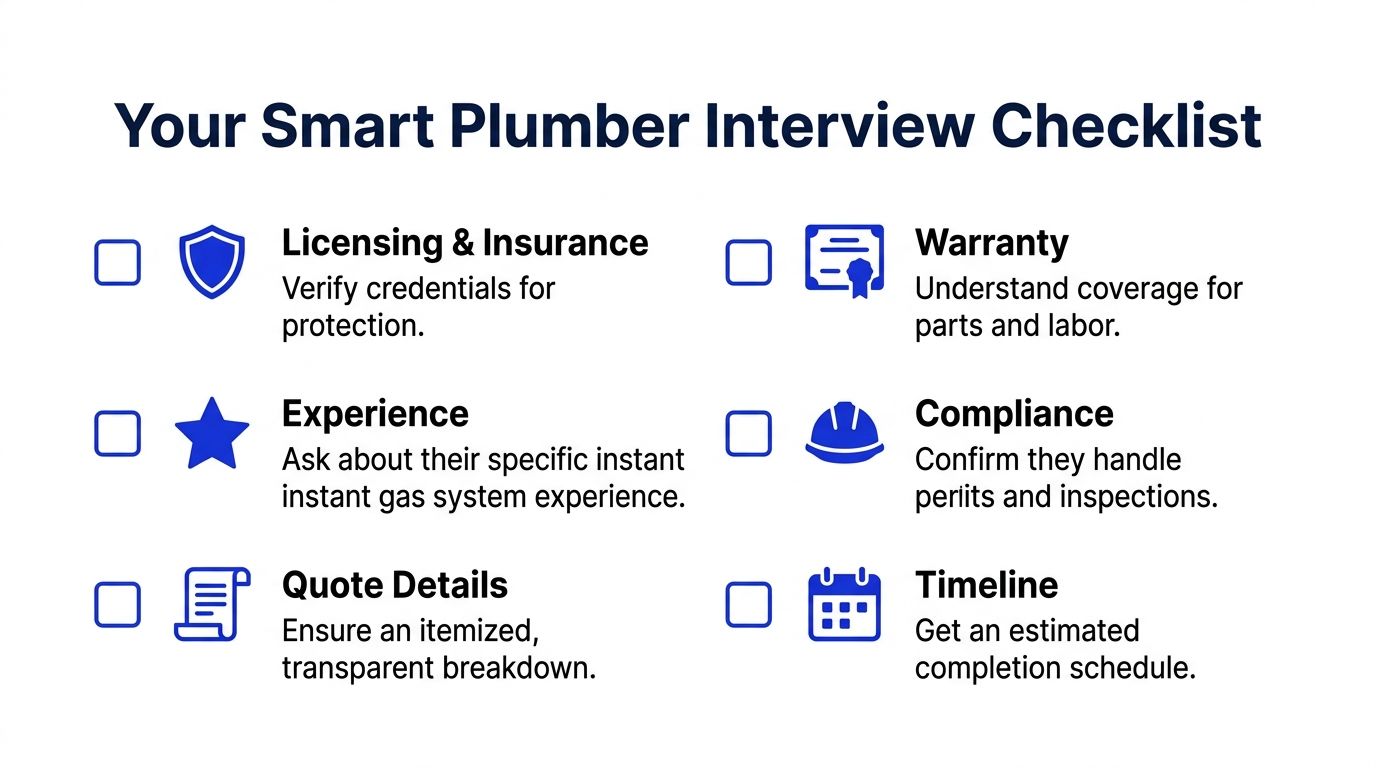
Ask these before you approve anything:
- Are you licensed for both plumbing and gas work? If gas is involved, this is basic due diligence.
- Is the quote itemised? You want to see the unit, labour, fittings, removal, and compliance clearly separated.
- Does the quote include disposal of the old system? Some homeowners assume it's included when it isn't.
- Are there any likely extras not included yet? A straight answer here can save an argument later.
A solid plumber won't be annoyed by these questions. They should answer them clearly.
If a contractor resists simple questions about licensing, compliance, or itemised pricing, keep looking.
Questions that matter after the install
The second group of questions is about what happens once the new system is on the wall.
Ask:
- What warranty applies to the unit, and what applies to workmanship?
- Will I receive the required compliance documentation?
- If the job changes on the day, how will extra work be approved?
- What maintenance do you recommend for this specific model and fuel type?
These questions do two things. They protect you from hidden cost creep, and they show whether the plumber is thinking beyond the sale.
A proper hot water installation should be clear before the work starts, safe when the work is finished, and supportable if something goes wrong later. That's the standard worth paying for.
If you need a clear, itemised quote for an instant gas hot water replacement in Caroline Springs, Taylors Hill, or anywhere across Melbourne's west, Total Plumbing & Hot Water Systems can inspect the existing setup, explain the installed cost, and help you sort out the fastest practical path back to reliable hot water.