



You step into the shower in Caroline Springs, turn the tap, and get nothing but cold water. Or worse, you notice a puddle around the hot water unit, hear a strange hiss, or smell gas near the system. That's usually the moment stress kicks in and people either freeze or start touching the wrong valve.
The right response is simple. Make it safe first, stop any damage you can, then call for help with the right information ready. In Melbourne's western suburbs, emergency hot water repair often comes down to quick triage. Is it a gas fault, an electrical fault, a leak, or a failed unit that needs a same-day changeover?
Hot water isn't just a comfort issue. In day-to-day housing practice, it's treated as an essential household service, which is why urgent loss of hot water needs a faster response than ordinary maintenance. If you're in Taylors Hill, Caroline Springs, or nearby, the practical steps below will help you stay safe and help your plumber get you back up and running faster.
Table of Contents
- No Hot Water Your First Five Minutes
- Isolate the System Safely Gas vs Electric
- Information to Provide for Fast Same-Day Service
- Costs Timelines and Guarantees in Melbourne West
- How to Avoid Another Hot Water Emergency
- Emergency Hot Water FAQs in Caroline Springs
No Hot Water Your First Five Minutes
The first five minutes matter more than commonly realised. If the unit has failed, leaking water or a live fault can do more damage than the breakdown itself. If the issue is gas-related, one wrong move can make a bad situation worse.
Start with three rules.
- Keep clear of obvious hazards. If you smell gas, hear hissing, see sparks, or find water near electrical parts, don't stand around the unit trying to diagnose it.
- Stop the system if it's safe to do so. That usually means isolating water and power or gas. The exact method depends on whether the unit is electric or gas.
- Don't try a DIY repair. Hot water systems are regulated plumbing appliances. Fault-finding on live electrical circuits or gas components isn't a job for guesswork.
During an actual emergency, people often lose time checking taps, pressing buttons, relighting things, or resetting breakers repeatedly. That rarely fixes the underlying fault. It can also hide the actual problem by making it intermittent.
Practical rule: If the unit is leaking, tripping power, giving off a gas smell, or has gone completely dead without an obvious reason, treat it as urgent.
A quick first response looks like this:
- Confirm the issue: Run hot water at one tap only. If no fixture has hot water, the problem is likely at the unit rather than one outlet.
- Check for visible trouble: Look for pooling water, soot marks, scorch marks, drips from fittings, or an error display if your unit has one.
- Keep others away: In family homes, make sure no one tries to turn the system back on while you're isolating it.
If the scene is safe, move straight to shutdown. That's what limits property damage and gives the best chance of a clean repair instead of a more expensive mess.
Isolate the System Safely Gas vs Electric
A hot water emergency doesn't have one shutdown method. Gas and electric systems need different handling, and that's where many people get caught out.
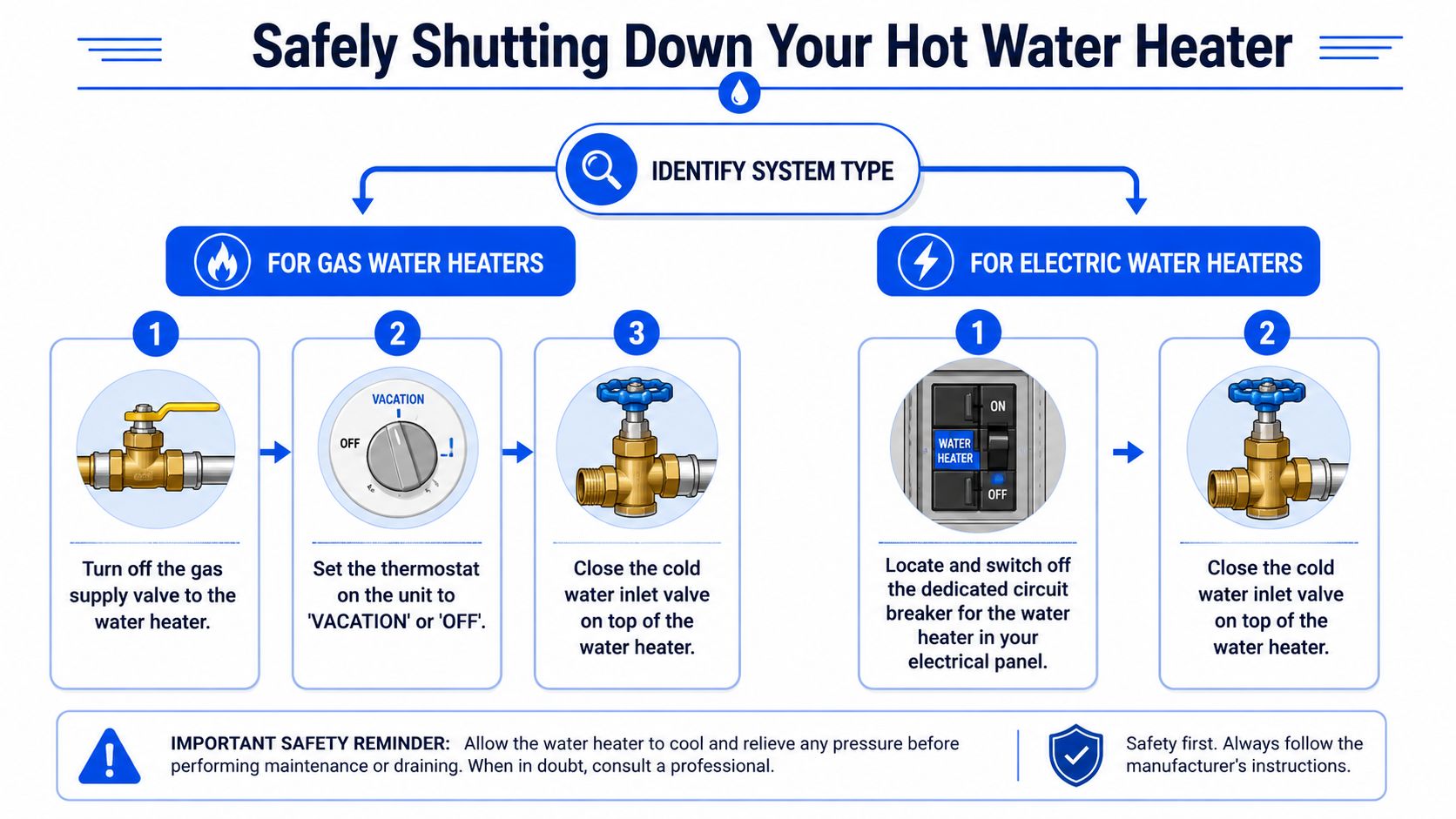
Here's the visual guide first.
Start with the same first check
Before touching anything, work out what type of system you have. A storage tank with electrical conduit usually points to electric. A unit with a gas line, flue, or gas control valve points to gas. Continuous-flow systems mounted on an external wall are often gas, but not always.
For either system, the common step is to find the cold water isolation valve feeding the unit. It's usually on the pipe entering the system. Turning that valve off helps stop the unit refilling and can limit further leaking.
After that, the method splits.
If you have a gas hot water unit
If there's any gas smell, take this seriously. Australian emergency guidance notes that you should turn off gas at the meter only if it's safe to do so, and avoid using electrical switches if gas is suspected because they can create a spark, as outlined in this summary of Energy Safe Victoria guidance for gas-related plumbing emergencies.
That means:
- If it smells like gas but the area feels safe enough to approach: turn off the gas supply valve.
- If the smell is strong or conditions feel unsafe: leave it alone, move people away, and call for urgent help.
- Don't use nearby switches: don't flick lights, exhaust fans, or power points on or off if gas may be present.
If the unit itself is safe to approach, set the thermostat or control to OFF or VACATION if that option exists, then close the cold water inlet. If you need licensed gas work beyond isolation, use a qualified gas fitting and line service rather than trying to relight, disconnect, or adjust gas components yourself.
A gas hot water fault can be more than “no flame”. It can involve ventilation, ignition, thermocouples, controls, or water-related damage affecting the burner area. Keep your response narrow and safe. Isolate only.
Later in the repair process, technicians in Melbourne's western suburbs who use a pre-diagnostic visual and thermal imaging workflow complete 94% of emergency replacements of gas and electric hot water units within 2 hours, according to the cited industry summary for Melbourne west conditions. That speed only helps if the site is safe to enter and assess.
A short video can help if you're under pressure and need to picture the shutdown process clearly.
If you have an electric hot water unit
Electric systems bring a different risk. Water around wiring, terminals, or the base of the unit can become dangerous quickly.
Use this order:
- Go to the switchboard. Find the dedicated breaker for the hot water service.
- Turn that breaker off. If you aren't certain which breaker is correct, don't start testing random ones while standing in a wet area.
- Return to the unit and close the cold water inlet valve if it's safe.
Don't remove covers. Don't inspect elements. Don't test wiring. If the unit has tripped the breaker, that can point to a failed element, moisture ingress, or another internal fault. It needs proper testing, not trial and error.
If water is pooling near an electric storage unit, the safest assumption is that both plumbing and electrical hazards may be present at the same time.
When not to touch anything further
Stop and wait for a licensed plumber or electrician if any of these apply:
- Strong gas odour
- Visible sparking or burning smell
- Water inside electrical enclosures or around exposed wiring
- A unit that won't isolate cleanly
- Any uncertainty about which valve or breaker controls the system
In an emergency hot water repair, the smart move isn't to do more. It's to do the few safe things correctly, then hand it over.
Information to Provide for Fast Same-Day Service
Once the system is isolated, the next job is communication. A rushed phone call with missing details often slows everything down. A clear call helps the plumber arrive with the right parts, the right unit size, and the right expectation of whether this is a repair or a replacement.
What makes it an emergency
Some faults can wait until business hours. Others shouldn't.
Treat it as urgent if you have:
- Active leaking from the tank or pipework around the unit
- No hot water at all in a household that needs same-day restoration
- A gas smell, burning smell, or soot marks
- Repeated breaker trips linked to the hot water service
- Commercial or rental property pressure where hot water loss affects occupancy
Complete loss of hot water is recognised in Victorian consumer practice as an urgent plumbing defect. That's why property managers and landlords usually need quick action rather than a loose booking window.
What to have ready when you call
The best emergency calls are short, calm, and specific. Gather this before you ring if you can do it safely:
- System type: gas, electric, solar-assisted, heat pump, or continuous flow
- Brand and model: look on the compliance plate or front panel
- Approximate age: even a rough estimate helps
- Fault symptoms: leaking, no ignition, no heating, tripping power, noisy tank, error code
- What you've already isolated: water valve, gas valve, or breaker
- Access details: side path, external wall unit, roof obstruction, tight cupboard, tenant on site
If the unit is external, take a photo of the front and the pipe connections. If it's internal, photograph any visible label and the area where the leak is showing. Good photos save time because they help identify whether the likely fix is a heating element, valve, thermostat issue, or a failed tank that needs changeover.
Repair now or replace now
Many homeowners get poor guidance. Australian consumer material gives limited help on the practical trade-off between fixing a failed component and replacing the unit, which leaves people guessing in the middle of an urgent breakdown, as noted in this summary on the repair versus replacement decision gap for emergency plumbing.
That gap matters because not every “repair” is good value.
A sensible phone triage usually asks:
- Is the tank itself leaking, or only a valve or connection?
- Is the unit older and already unreliable?
- Is the repair a contained component swap, or does it involve multiple fault points?
- Will the repaired system still suit the property, or is the household already outgrowing it?
If the tank body has failed, replacement is usually the cleaner path. If the issue is limited to a serviceable component and the rest of the unit is sound, repair can make sense. The point is to avoid spending emergency money on a stopgap when the unit is already near the end of its useful life.
Costs Timelines and Guarantees in Melbourne West
People usually ask two questions first. How much will this cost, and how long will I be without hot water? Both are fair questions, especially when the failure hits at night or on a weekend.
Why after-hours work costs more
Emergency hot water repair often costs more outside standard weekday hours for a straightforward reason. The national Plumbing and Fire Sprinklers Award 2020 sets distinct penalty structures for after-hours, weekend, and public-holiday work, and that framework helps explain why a Saturday evening or public holiday callout can cost materially more than a normal booking.
That doesn't mean every emergency becomes a major bill. It means labour is priced differently when the work happens under penalty-rate conditions. Add to that the reality of carrying parts, attending urgently, and sometimes removing and replacing a failed unit on the spot.
For Melbourne west households, the most useful way to think about cost is not “What's the cheapest visit?” It's “What gets safe, reliable hot water back with the least wasted spend?”
A cheap after-hours patch on a failing tank can be the most expensive option if you're paying again a week later.
Repair vs Replace Decision Matrix
| Factor | Lean Towards Repair | Lean Towards Replacement |
|---|---|---|
| Fault location | Isolated valve, thermostat, element, ignition-related component | Tank body leak, severe corrosion, multiple failing parts |
| System history | First significant breakdown after otherwise steady service | Repeated faults, recurring outages, prior patch repairs |
| Urgency outcome | Part can restore service safely and cleanly | Changeover will restore service more reliably the same day |
| Property plans | Short-term hold, future renovation already planned | Long-term home, rental reliability, better fit needed now |
| Technology fit | Existing system still suits household demand | Current setup is undersized, outdated, or no longer suitable |
What same-day changeover usually depends on
A same-day replacement is often possible when the site is accessible, the unit type is clear, and the replacement path is straightforward. The practical variables are simple:
- Like-for-like swap: easiest if the new unit matches the fuel type and location
- Access: tight cupboards, roof spaces, and difficult side passages slow things down
- Compliance work: gas, flueing, valves, drainage, and electrical isolation must all be correct
- Stock availability: common sizes and brands move faster than unusual setups
If you're comparing options, a specialist hot water team usually gives the clearest path because they can assess both repair and replacement without pushing one answer by default. A local hot water systems service in Melbourne's west is useful when you need that kind of same-day judgement instead of a one-size-fits-all recommendation.
Ask about workmanship guarantees, removal of the old unit, and payment flexibility before approving the job. Those details matter when the repair is unexpected and the decision has to be made quickly.
How to Avoid Another Hot Water Emergency
Once a unit fails unexpectedly, most homeowners don't want theory. They want to know how to stop it happening again.
Preventing the next emergency is usually less about doing one clever thing and more about staying ahead of the obvious wear points. Storage systems age from the inside. Continuous-flow and heat pump systems need correct diagnosis and compliant servicing. Neglect is what turns a manageable service job into an urgent callout.
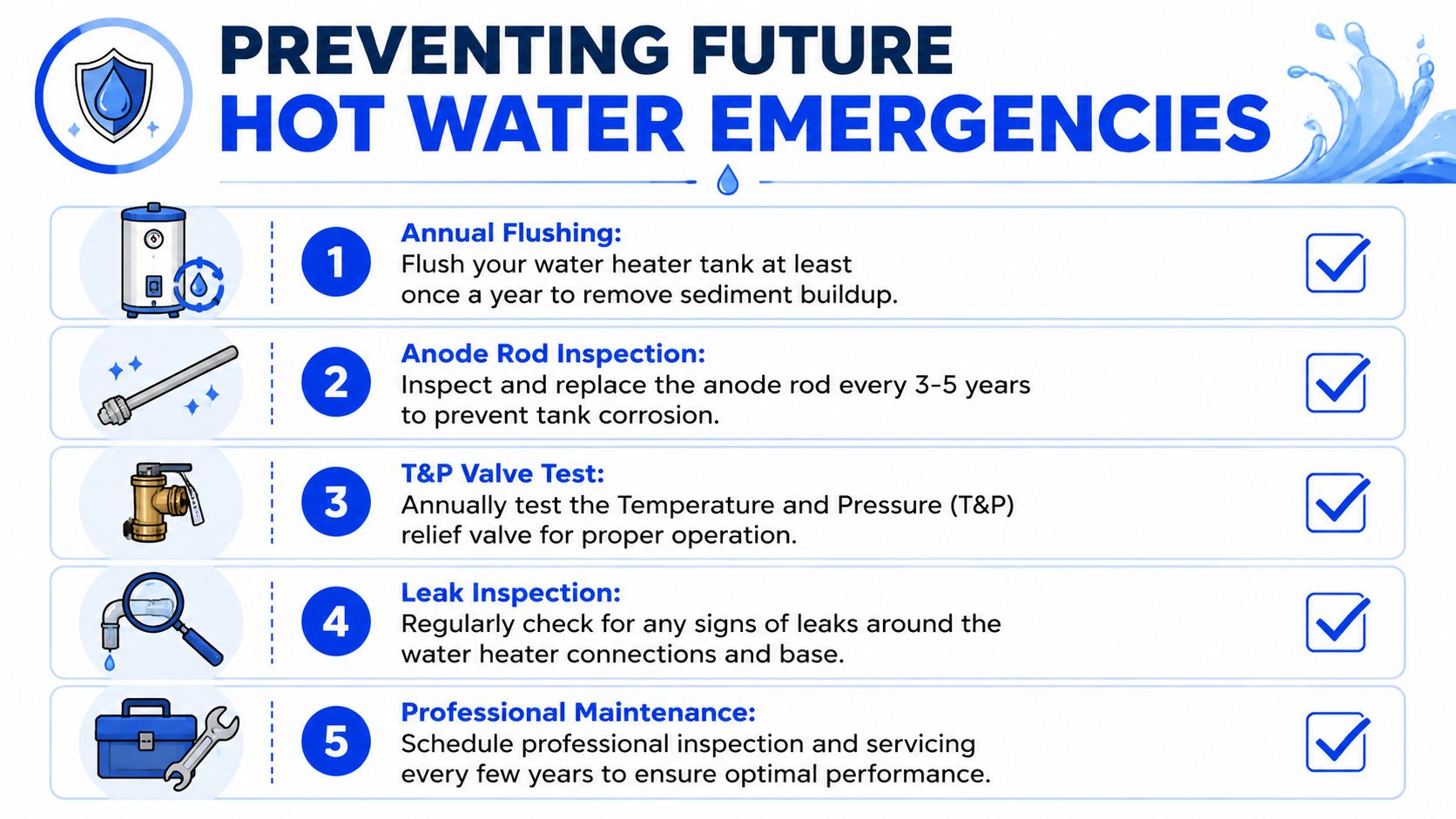
The maintenance jobs that matter
Focus on the jobs that change outcomes:
- Tank flushing: sediment buildup affects performance and can shorten system life.
- Anode rod checks: on storage tanks, this is one of the big corrosion control items.
- Valve inspection: relief valves and isolation valves need to operate properly when required.
- Leak checks: small drips around fittings often show up before major failures.
- Professional servicing: especially important on gas, solar, and heat pump units where diagnosis is more specialised.
If your system makes new noises, struggles to keep up, or gives intermittent hot water, don't ignore it because it still “sort of works”. That middle stage is where many avoidable breakdowns sit for months.
Plan replacement before the tank decides for you
The most cost-effective replacement is often the one you choose before the emergency. That gives you time to compare system types, location constraints, running-cost goals, and household demand properly.
Australia's hot water market has shifted because the Federal Government's Small-scale Renewable Energy Scheme has supported broader uptake of newer system types, pushing replacement of many older electric storage systems and making hot water work more specialist and compliance-sensitive, particularly with heat pumps and solar systems in the mix, as described in this summary of SRES-driven changes in Australian hot water system adoption.
That matters in practical terms. If you're still running an ageing conventional tank, your next emergency hot water repair might not be a simple element swap. It may be the point where a heat pump, solar-compatible setup, or a modern continuous-flow unit becomes the smarter long-term move.
If your current unit is ageing and you already worry about it before winter, start planning now. Emergency replacement should be the backup plan, not the strategy.
For many Melbourne west homes, the best prevention is a scheduled inspection, a realistic replacement plan, and no denial about the condition of an old system.
Emergency Hot Water FAQs in Caroline Springs
Can a hot water unit be replaced the same day in Caroline Springs or Taylors Hill
Often, yes. In Melbourne's western suburbs, 94% of emergency replacements of gas and electric hot water units are completed within 2 hours when technicians follow a pre-diagnostic visual and thermal imaging workflow, according to the verified Melbourne west summary provided for this topic. That's one reason local diagnosis matters. Fast replacements depend on correct triage before tools come out.
For area-specific support, it helps to use a local Caroline Springs hot water systems plumber who already works with the common property layouts and access conditions in the west.
What should tenants do if there is no hot water
Report it immediately to the agent or landlord as an urgent issue and include photos if safe to take them. If there's leaking, a gas smell, or any electrical concern, isolate only what you can safely isolate and tell them exactly what you've done. Clear information speeds approval and dispatch.
Can I switch from a storage tank to continuous flow
Sometimes, yes, but it isn't always a straight swap. Gas supply, pipe sizing, ventilation clearances, and location all matter. For example, Rinnai continuous-flow systems require a minimum 150mm clearance for ventilation in the verified data for this topic, so the existing position may or may not suit the new unit.
Is every loss of hot water a full replacement job
No. Some failures are still clean repairs. A failed component is very different from a leaking tank body or a unit with several issues stacking up at once. The right call depends on the fault itself, not just the inconvenience.
Does local experience really make a difference
Yes. In Caroline Springs and Taylors Hill, a plumber who regularly handles emergency hot water repair in the west will usually recognise the common layouts, access issues, and unit types faster than someone arriving cold. That shortens diagnosis and helps avoid wasted visits.
If you need fast, calm help with a leaking, failed, gas, or electric hot water unit, Total Plumbing & Hot Water Systems provides 24/7 callouts across Caroline Springs, Taylors Hill, and Melbourne's western suburbs. They handle repairs, same-day hot water changeovers, old unit removal, and compliant installations, with clear communication and practical advice from a fully licensed local team.