





A cold shower is usually how this starts. You turn on the tap, wait for the water to warm up, and nothing changes. If your home has an older gas storage unit, there's a fair chance the problem sits behind a small access panel near the bottom of the heater. The pilot light has gone out, or it's trying to tell you something is wrong.
That tiny flame does a much bigger job than is often realised. In a pilot light hot water system, it's the first step in getting hot water to your kitchen, bathroom and laundry. When it's working properly, you never think about it. When it isn't, the whole system stops feeling dependable.
Around Melbourne's western suburbs, this is one of the more common gas hot water issues homeowners run into. Some relights are simple. Some are a warning sign. If you're trying to work out which is which, the useful starting point is understanding how the system works and why it fails the way it does.
Table of Contents
- Your Guide to Gas Hot Water Pilot Lights
- Understanding How Your Pilot Light Works
- Symptoms of a Failing Pilot Light
- A Safe Guide to Relighting Your Hot Water System
- Why Your Pilot Light Keeps Going Out
- Repair or Replace Your Hot Water System
Your Guide to Gas Hot Water Pilot Lights
Most homeowners don't go looking for information about pilot lights on a good day. It's usually after a shower goes cold halfway through, the kids are asking why there's no hot water, or the unit has clicked, hissed or gone silent and you're standing there wondering if this is a quick fix or a job for a licensed plumber.
A gas storage heater with a standing pilot can be reliable for years, then suddenly stop doing the one thing you expect from it. That's frustrating, but it doesn't always mean the whole unit has failed. Sometimes the pilot has gone out. Sometimes the pilot keeps going out because another part is no longer doing its job safely.
That difference matters. Relighting a healthy system is one thing. Repeatedly relighting a faulty one is something else.
If you want a clear picture of what you're dealing with before booking a repair, it helps to understand the basics of gas and electric hot water system services in Melbourne's west. The issue may be as small as a pilot outage or as involved as a worn gas control component.
Practical rule: If the pilot light goes out once, you can treat it as an event. If it keeps happening, treat it as a fault.
A good plumber doesn't just relight the unit and leave. They look at why the flame failed, whether the safety device is responding correctly, whether there's a draft or combustion issue, and whether the repair makes sense for the age and condition of the system.
That's the approach homeowners need too. Stay calm, stay safe, and focus on cause before cure.
Understanding How Your Pilot Light Works
A pilot light hot water system is simple once you know the roles of the main parts. The easiest way to think about it is as a small safety chain. One part makes the flame. One part checks that the flame is really there. One part allows the main burner to fire only when that check is passed.
A pilot-light gas storage hot water system uses a small continuously burning flame to ignite the main burner, and the assembly commonly includes the pilot, ignitor, and a thermocouple or thermopile that keeps the gas valve open only when the pilot flame is proving safe combustion. If the pilot flame is absent, the heater won't produce hot water, as explained in this overview of pilot light operation in gas water heaters.
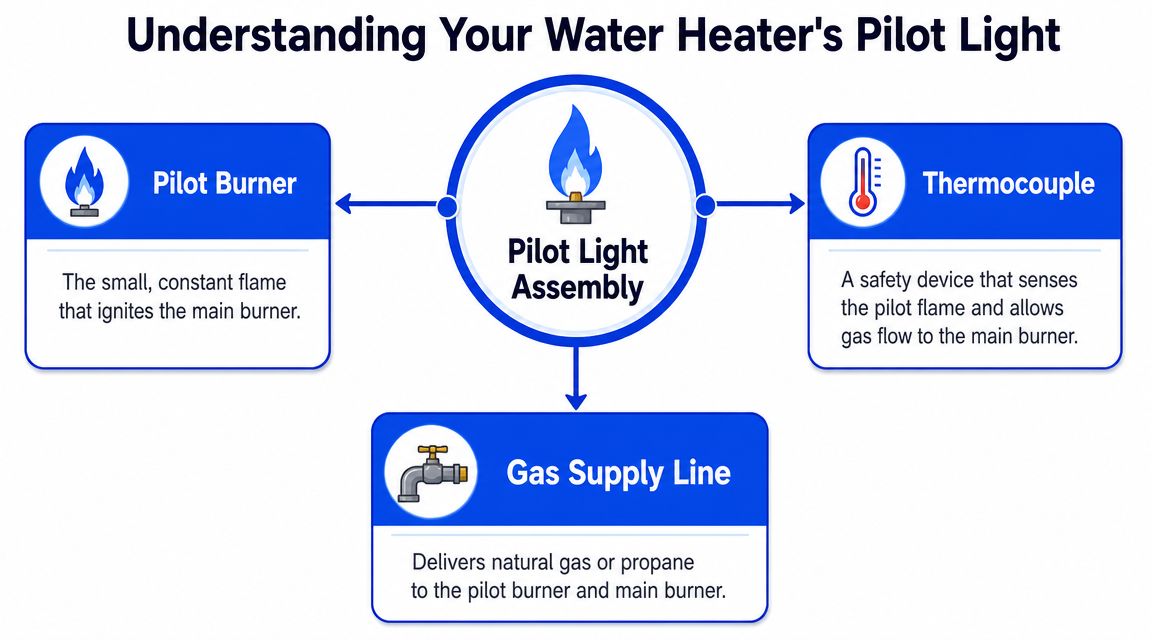
The small flame with the big job
The pilot burner is the small flame that stays on all the time in older-style systems. Its job isn't to heat the whole tank by itself. Its job is to be ready. When the water heater calls for heat, that pilot flame ignites the larger main burner.
The gas supply line feeds the fuel that makes all of this possible. If gas flow is weak, interrupted or contaminated by debris at the pilot assembly, the flame often becomes weak, unstable or difficult to keep lit. That's one reason licensed work matters when gas components need attention. If you need regulated work on valves, appliances or pipework, licensed gas fitting and gas line services are the right category of help.
Why the thermocouple matters
The thermocouple is the safety device that stops this system from becoming dangerous. A good analogy is a sentry at a gate. The pilot light is the worker on duty. The thermocouple is the sentry who will only keep the gate open if it can clearly see that worker standing in place.
Here's what that means in practice:
- Pilot flame on the thermocouple: The thermocouple heats up and tells the gas valve it's safe to stay open.
- Pilot flame weak or missing: The thermocouple cools down and the gas valve closes.
- Gas valve closed: No gas flows to the burner, which prevents unburnt gas continuing into the unit.
That's why a heater with a bad thermocouple often behaves in a very specific way. You light the pilot, hold the button, the flame appears normal, then it dies the moment you let go. The system isn't being difficult. It's refusing to stay open because the safety proof hasn't been satisfied.
A pilot light isn't just an ignition source. It's part of the heater's proof-of-safety system.
Once homeowners understand that, the rest of the troubleshooting makes more sense. A failed relight isn't always about the flame itself. Often the underlying problem is that the system no longer trusts what it's seeing.
Symptoms of a Failing Pilot Light
No hot water is the obvious symptom, but it's rarely the only one. In many homes, the system gives warnings first. They're easy to miss if you've never been shown what to look for.

What you can notice before complete failure
A healthy pilot flame should look steady and purposeful. When it starts flickering, shrinking, lifting away from the thermocouple or changing colour, that usually means something else in the system has changed.
Common signs include:
- Intermittent hot water: The unit works one day and fails the next. That often points to a pilot flame or safety component that's becoming unreliable.
- A weak or unstable flame: If the flame looks lazy, uneven or easily disturbed, it may not be heating the thermocouple properly.
- Pilot won't stay lit after release: This often suggests the thermocouple isn't generating the signal the gas valve needs.
- Sputtering or unusual burner behaviour: Restricted gas flow or dirt in the pilot assembly can cause rough ignition or inconsistent burning.
- The pilot goes out on windy days: Drafts and ventilation issues can interfere with a small standing flame more easily than people expect.
Some homeowners also notice they have to relight the system more than once. That's not maintenance. That's a symptom.
When to stop and call for help
There's a line between observation and hands-on fault-finding. You can safely note what the flame looks like, whether the outage is occasional or constant, and whether other gas appliances seem normal. You shouldn't start dismantling gas components to see what's happening inside.
Stop and get professional help if you notice any of the following:
- Gas odour near the unit: Don't try to relight it. Leave the area and follow the appropriate safety process.
- Scorching, soot or signs of improper burning: Those signs can point to combustion problems, not just a simple pilot outage.
- Repeated failures after relighting: If it lights and dies again, the fault hasn't been solved.
- Burn marks, corrosion or water around the base: Once moisture and gas components meet, diagnosis should stay with a licensed technician.
If you're asking yourself whether one more relight attempt is a good idea, that hesitation is often the sign to stop.
The useful habit is to observe without improvising. A clear description of the symptom helps a plumber diagnose faster and helps you avoid taking risks that don't solve the cause.
A Safe Guide to Relighting Your Hot Water System
Relighting a pilot light hot water system should be done slowly and deliberately. This isn't a job for guesswork, shortcuts or repeated clicking while hoping something catches. The safety steps matter because you're dealing with gas, ignition and a confined combustion area.
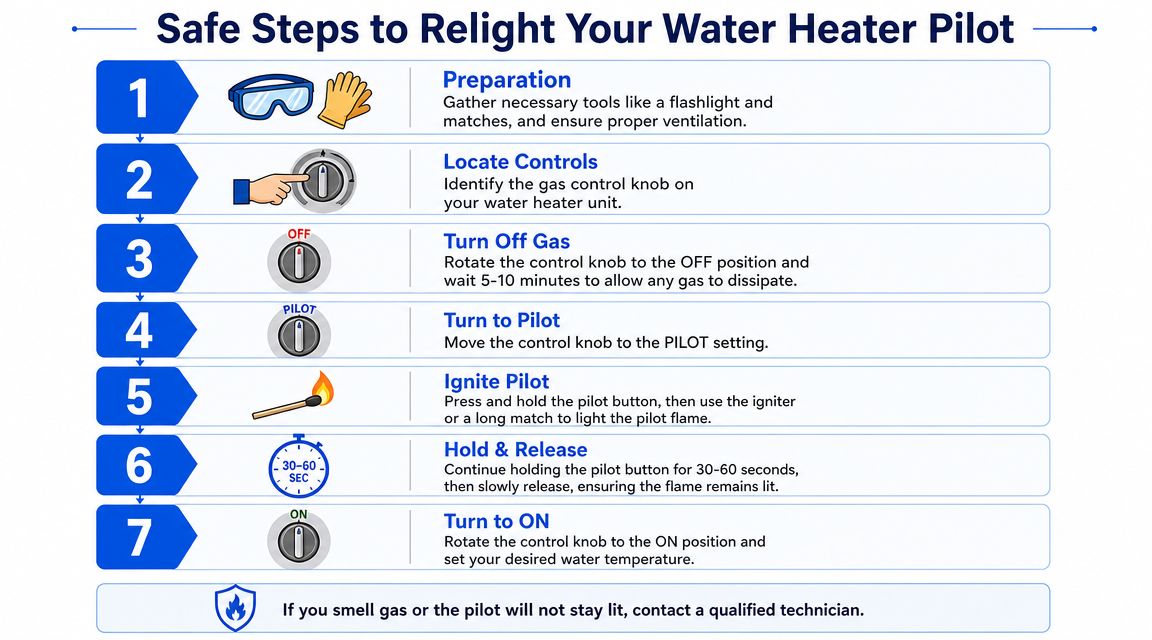
This visual guide shows the general flow before you begin.
Before you touch the controls
Start with the basic question. Can you smell gas? If the answer is yes, don't proceed. Don't test it again with a flame. Don't keep trying the ignitor. Follow gas safety advice and contact the appropriate professional help.
If there's no gas smell, locate the lighting instructions on the unit itself. Many heaters have them printed on a label near the gas control valve. The exact control layout varies by make and model, so the unit instructions take priority.
Manufacturers commonly specify a five-minute purge after turning the gas control to Off, then holding the control in Pilot while pressing the ignitor. The thermocouple must be heated for roughly 30–60 seconds so it can generate the millivolt signal that holds the gas valve magnet open, according to these manufacturer relighting instructions for gas water heaters.
The relighting process and the reason behind each step
Turn the control knob to Off
This stops gas flow to the pilot and burner. It resets the process and prevents gas continuing to feed while you prepare.Wait for the full purge period
The waiting period matters because any residual gas in the combustion area needs time to disperse. People often rush this step because nothing seems to be happening. In reality, this is the step that reduces the chance of igniting trapped gas.Set the control to Pilot
This prepares the valve to send gas only to the pilot circuit when you press and hold the control.Hold the pilot button or control knob in
While you're holding it, you're manually allowing gas to reach the pilot. If you let go too soon, the gas flow stops before the thermocouple has had a chance to prove the flame.
A quick visual can help if your unit layout feels unfamiliar.
Press the ignitor
You should see the pilot ignite. If your model uses a manual lighting method, only follow the manufacturer's instructions.Keep holding for long enough
This is the step most often cut short. The thermocouple needs sustained heat. If you release too early, it cools before it can hold the valve open.Release slowly and watch the flame
If the flame stays lit, turn the control to On. If it dies immediately, stop repeating the process over and over. That usually means there's an underlying fault.
A simple checklist helps:
- Use a torch: You need to clearly see the pilot area.
- Keep the area ventilated: Good airflow around you matters, but strong drafts directly into the burner compartment don't.
- Don't force controls: If a knob jams or feels wrong, stop.
- Limit repeat attempts: Several failed relights usually indicate a component or gas issue, not bad luck.
Safety note: Waiting feels inconvenient when you want hot water back quickly. It's still one of the most important parts of the process.
Why Your Pilot Light Keeps Going Out
If the pilot relights but won't stay reliable, the outage is only the symptom. The underlying issue usually sits in one of three groups. The environment around the heater, the condition of the pilot assembly, or a failing safety or control part.
Pilot-light operation has been part of gas water heating for a long time. The domestic lineage began in 1868, when Benjamin Waddy Maughan patented the first instantaneous water heater for domestic use, and by 1880 Edwin Ruud had patented the first automatic storage gas water heater. Ruud's early design used a pilot light, establishing the principle that became common in these systems, as noted in this short history of domestic hot water systems.
Environmental causes
The pilot flame is small by design. That makes it effective, but also vulnerable.
A draft near the unit can push the flame away from the thermocouple. When that happens, the thermocouple stops receiving steady heat and the gas valve closes. Homeowners often notice a pattern here. The pilot goes out after windy weather, after a door has been left open near the unit, or after changes around the cupboard, enclosure or flue area.
Insufficient combustion air can create trouble too. Gas appliances need the right air supply to burn cleanly and consistently. If a heater is boxed in too tightly, surrounded by stored items, or affected by ventilation problems, the flame can become unstable.
Maintenance and component faults
This is the category I see most often in older systems. The pilot assembly gets dirty, the flame weakens, and people keep relighting it because the heater still sometimes works.
Typical causes include:
- Dirty pilot assembly: Dust, grime or corrosion can restrict gas flow at the pilot.
- Thermocouple deterioration: Over time, the sensor may stop responding properly to heat.
- Control valve issues: If the valve isn't holding open correctly, the pilot may fail even when the flame is present.
- Gas pressure fluctuation: If supply conditions are inconsistent, the pilot can become weak or erratic.
The relighting guidance linked earlier also notes that persistent outages are often associated with gas pressure fluctuations, drafts, insufficient combustion air, dirty pilot assemblies, or control-valve and thermocouple failure. That's the useful mindset shift. A repeat outage usually isn't normal behaviour for an otherwise healthy heater.
A pilot that keeps going out isn't asking to be relit again. It's asking to be diagnosed.
There's also a practical reason not to delay. The longer a weak pilot, dirty assembly or failing thermocouple is left alone, the more time you spend without reliable hot water and the more likely it is the failure will become complete.
Repair or Replace Your Hot Water System
Once a pilot light problem has been confirmed, the next question is whether you repair the existing unit or move on from it. The right answer depends on condition, reliability and how much confidence you still have in the system.
In Australia, gas remains relevant in many homes. In 2021, about 47% of Australian households used natural gas for cooking or heating, which helps explain why gas-fired and pilot-light hot water systems are still common in many properties, as referenced in this overview of Australian household gas use and hot water system options.
When a repair still makes sense
Repair is usually the sensible option when the fault is localised and the rest of the unit is in decent condition. A single thermocouple issue, a pilot assembly clean, or one failed gas control component can be a straightforward repair if the tank and burner are otherwise sound.
A repair tends to make more sense when:
- The unit has been reliable up to now
- The tank itself shows no sign of leaking
- The issue is clearly tied to one serviceable part
- You want to restore hot water quickly without changing the whole system
For homeowners in the western suburbs comparing options, a licensed assessment and hot water repairs or replacements in Melton and surrounding areas can help determine whether the current unit is worth keeping in service.
When replacement is the smarter call
Replacement becomes the better decision when the pilot issue is only one problem in a longer list. If the burner is inconsistent, the controls are unreliable, the tank is showing its age, and you've lost trust in the system, throwing another repair at it can become false economy.
Here's a practical decision guide.
| Consideration | Best to Repair If… | Best to Replace If… |
|---|---|---|
| Fault type | The problem appears limited to the pilot assembly or one gas control component | The pilot issue sits alongside broader reliability problems |
| System condition | The tank, burner and casing appear sound | Corrosion, leaks or multiple worn parts are present |
| Recent history | This is the first significant fault in a long time | You've had repeat breakdowns or ongoing hot water interruptions |
| Confidence | You'd reasonably expect more service life after repair | You no longer trust the unit to stay dependable |
| Upgrade value | Existing performance still suits the household | You want a more modern system with simpler ignition and improved day-to-day convenience |
What doesn't work is making the decision based only on whether the pilot can be relit today. A unit can relight and still be at the end of a practical service life. It can also fail to relight and still be worth repairing if the cause is small and the rest of the heater is in good order.
A good plumber should explain both paths clearly. Repair if the unit still has life in it. Replace when the repair only postpones a bigger problem.
If your pilot light has gone out once, won't stay lit, or keeps failing after relighting, Total Plumbing & Hot Water Systems can inspect the unit, identify the underlying fault, and advise whether a safe repair or a full changeover makes more sense for your property.