




If you live in Caroline Springs, Taylors Hill, Truganina or nearby, you've probably noticed one of these before you ever thought about water filters. White crust around taps. A chlorine smell in a glass of water. Shower screens that mark up quickly. Kettles and coffee machines that seem to age faster than they should.
That doesn't mean your tap water is unsafe. It does mean many homeowners want something better than “good enough” from the water running through their home. In Melbourne's west, that usually comes down to taste, hardness, appliance protection, and wanting a system that's installed properly instead of clipped in as an afterthought.
Water filter installations aren't just a niche upgrade anymore. They've become part of the way people plan kitchens, laundries, hot water replacements and full renovations in this part of Melbourne.
Table of Contents
- Why More Melbourne Homes Are Filtering Their Water
- Choosing Your Filter Type Whole House Under Sink and RO
- The Best Water Filter for Your Home in Melbourne's West
- What to Expect During a Professional Installation
- DIY vs Professional A Guide to Compliance and Risks
- Understanding Costs Maintenance Schedules and Warranties
- Water Filter FAQs and Your Next Steps
Why More Melbourne Homes Are Filtering Their Water
A common call starts the same way. The homeowner isn't panicking. They're just over it. The water tastes a bit chemical, the shower glass won't stay clean, and a kitchen renovation is already underway, so they want to know whether now is the right time to add a filter.
That thinking lines up with the wider trend. Demand for water filtration and purification products in Australia grew by around 4–5% annually between 2016 and 2021, driven mainly by urban households in Victoria installing under-sink filters and reverse-osmosis units, particularly in suburbs with higher-alkalinity or older mains networks, according to this Australian water filtration market summary.
For homeowners in Melbourne's western suburbs, the reason usually isn't fear. It's practicality. People want better-tasting drinking water, less smell from chlorine, fewer marks on fixtures, and less wear on appliances that rely on a steady water supply.
What people are usually trying to fix
Some households only care about the water they drink. Others are dealing with a broader whole-of-home issue.
- Taste and odour: Kitchen tap water can be safe but still unpleasant to drink.
- Hard water signs: Scale on tapware, kettles and shower heads is often what gets people looking into filtration.
- Appliance protection: Dishwashers, coffee machines and hot water systems all benefit when water quality is considered properly.
- Renovation timing: A new kitchen, laundry or bathroom is often the easiest point to add filtration neatly.
The best time to install a filter is usually when you're already touching the plumbing. It's cleaner, simpler and easier to do properly.
Why generic advice often misses the point
A lot of online advice treats every house the same. Melbourne's west isn't the same as every other area. Cabinet layouts vary. Water quality varies. Older homes and newer estates can present completely different installation issues even when they're only a few suburbs apart.
That's why good water filter installations start with the actual property, not the product box. The right system for one home can be the wrong one for the next.
Choosing Your Filter Type Whole House Under Sink and RO
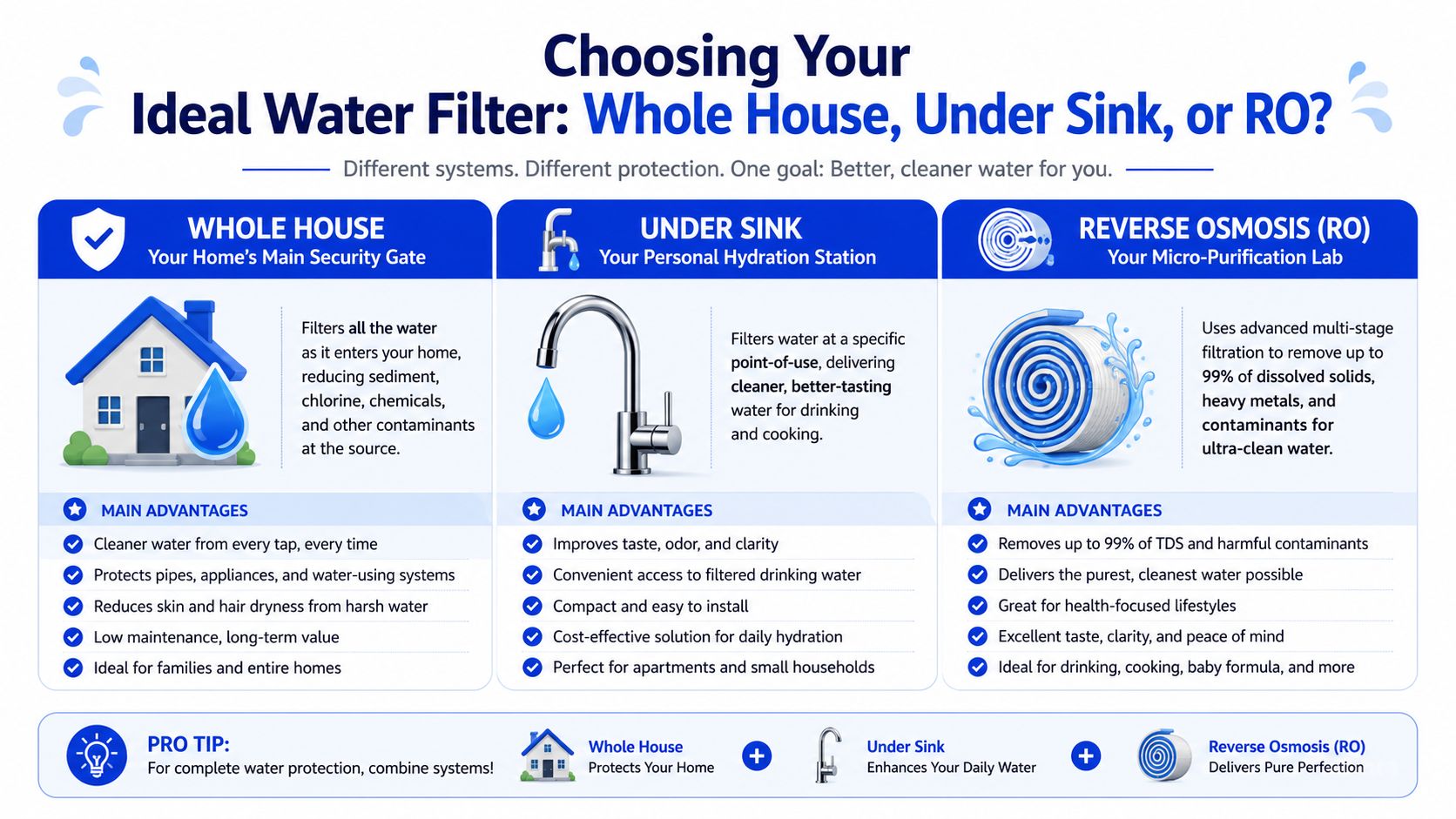
There are three filter setups most homeowners look at. The easiest way to think about them is like levels of coverage. One protects the whole property. One targets a single tap. One goes further for drinking water purity.
Whole house systems
A whole house system sits on the main water line and treats water as it enters the property. Every cold outlet downstream benefits, and depending on the design, so do showers, toilets, laundries and appliances.
This suits households that care about more than drinking water. If you're trying to reduce sediment, improve general water quality through the house, or protect fixtures and appliances, this is usually where the conversation starts.
What works well:
- Main-line protection: It treats water before it reaches the rest of the home.
- Cleaner maintenance planning: One central location is easier to service than multiple small devices scattered around the house.
- Better fit for broader complaints: Useful when the issue isn't only kitchen drinking water.
What doesn't:
- Treating a small issue with a big system: If you only dislike the taste from one kitchen tap, a whole house system can be more than you need.
- Poor placement: If there isn't enough clearance around housings and valves, future servicing becomes annoying fast.
Under sink filters
An under sink filter is a point-of-use system. It's fitted inside the kitchen cabinet and usually feeds either the existing cold tap through a diverter arrangement or a dedicated drinking water tap.
This is the practical choice when the goal is simple. Better tasting water for drinking and cooking, without changing the rest of the house.
A good under sink setup makes sense when:
- The kitchen is the priority: You want cleaner water from one location.
- Cabinet space is limited but manageable: Standard cartridge systems still need room for access.
- You want a lower-impact install: Less pipework, less disruption, more targeted result.
Reverse osmosis systems
A reverse osmosis system, usually called RO, is the high-purity option for drinking water. It uses a membrane and multiple stages to reduce a wider range of contaminants than a basic carbon cartridge setup.
RO can be excellent when homeowners are very particular about taste or want a more intensive drinking water solution. It also needs more planning than people expect.
Practical rule: RO is for drinking water performance, not as a substitute for solving every water issue across the whole property.
Trade-offs matter here:
- More components: There's more to install, maintain and check.
- Drain connection compliance: Wastewater discharge has to be handled properly.
- Space and layout: Tight cabinets, awkward traps and older pipework can make a “simple” install less simple.
If you want broad house coverage, choose whole house. If you want one better drinking tap, choose under sink. If you want the highest level of purification at the kitchen sink, RO is usually the strongest candidate.
The Best Water Filter for Your Home in Melbourne's West
The best system depends less on branding and more on what's coming through your pipes and what problem you're trying to solve. In Melbourne's west, two things often shape the decision. Chlorine levels matter for taste and cartridge life. Hardness matters for maintenance and how the system performs over time.
What local water conditions change
A 2018 report found that average residual chlorine at service entry points in the western Melbourne region ranged from 0.2–1.0 mg/L, and ANSI/NSF‑42 guidance indicates that chlorine-removal media in such environments may require replacement every 3–5 years, compared to 5–7 years in low-chlorine supplies, as outlined in this NSF consumer guidance on water treatment standards.
That has a practical effect. A filter that looks fine on paper can disappoint in service if the homeowner expects a generic replacement schedule to apply forever. In this area, cartridge selection and maintenance planning need to match local conditions.
Melbourne Water reporting has also been noted as showing moderate-to-hard water in Melbourne's western region. In real terms, that often shows up as scale, reduced appliance efficiency, and more pressure on membranes and cartridges where systems are undersized or poorly matched.
Which setup suits which household
If your biggest complaint is what comes out of the kitchen tap, an under sink carbon system or an RO setup is usually the cleanest solution. If the whole home shows hard water signs, a point-of-entry setup makes more sense because it addresses the house at the front door, not just one room.
Here's the simplest way to decide:
- Choose under sink if drinking water taste is the main issue and you want a focused kitchen solution.
- Choose RO if you want a higher-purity drinking water result and have the cabinet space and compliant drainage options to support it.
- Choose whole house if you're seeing effects across showers, laundry, appliances and general household use.
For many homes around Caroline Springs, Taylors Hill and surrounding suburbs, the best answer is a combination. A whole house sediment and carbon arrangement for general protection, then a more refined drinking water system at the sink where it matters most.
If you're local and want a plumbing-first assessment rather than a retail pitch, it helps to speak with a plumber in Tarneit who understands western suburbs water conditions.
If a system choice doesn't mention cartridge life, access for servicing, and how it connects to your existing plumbing, it's not a complete recommendation.
What to Expect During a Professional Installation
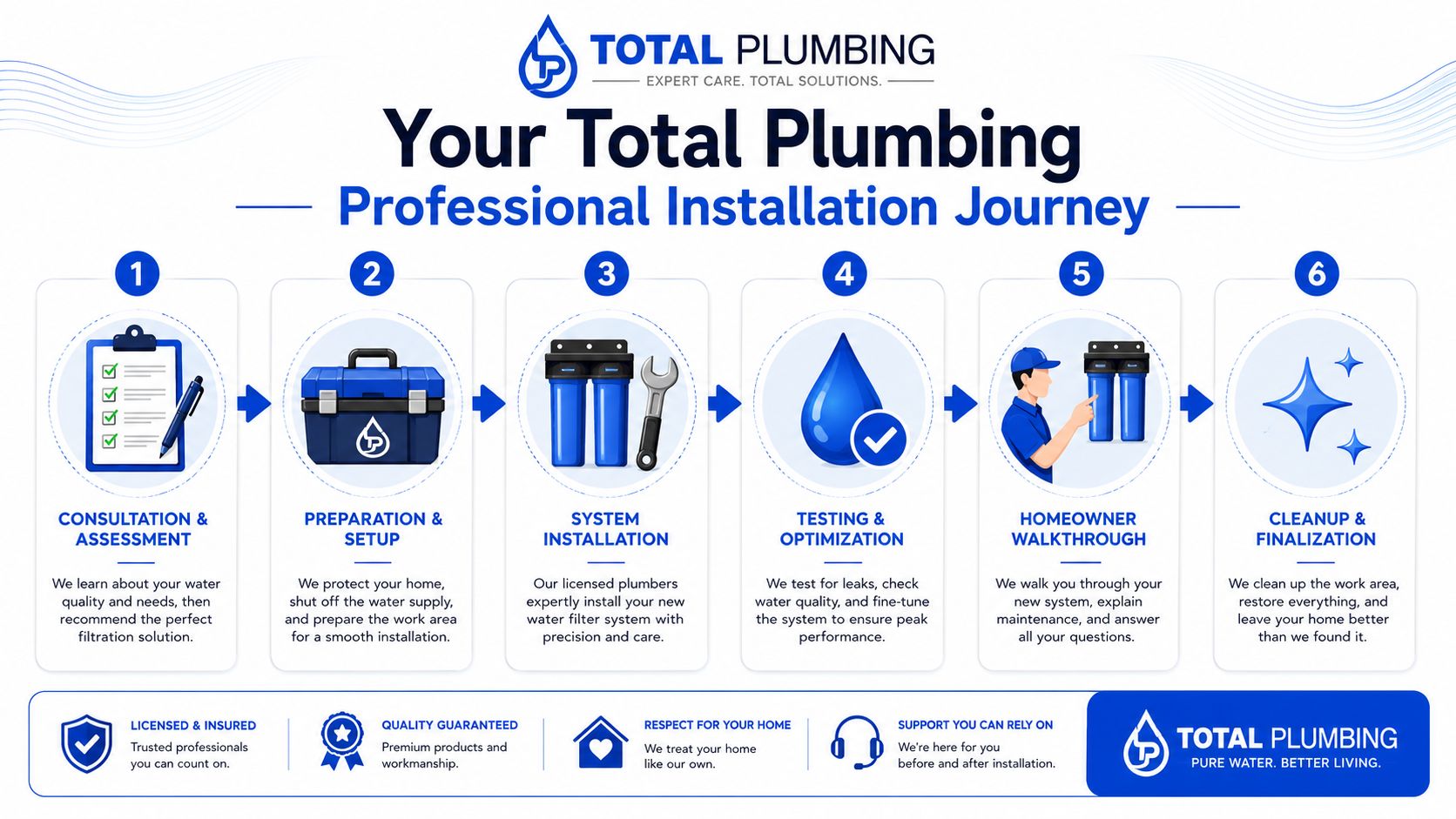
Most homeowners don't need the technical detail of every fitting and valve. They do want to know whether the job will be messy, how long the water will be off, and whether the finished setup will be easy to maintain. A proper installation should feel organised from the first inspection to the final handover.
Before the tools come out
The first step is assessing the property, not just picking a filter. The plumber checks where the main line runs, how much room exists around the proposed install point, what pipe material is in place, and whether there's enough service clearance for future cartridge changes.
For under sink and RO units, cabinet layout matters just as much. Trap position, available mounting space, nearby power if required by the system, and a compliant drain path all need checking before anything is approved.
A good installation plan usually includes:
- Location check: Enough access to isolate, remove housings and service the unit later.
- Pressure review: The incoming pressure and protection requirements are confirmed.
- Connection planning: Existing taps, valves, drain lines and hot water layouts are reviewed.
- Maintenance access: Filters that can't be reached easily become expensive to own.
Later in the process, homeowners often want to see what the job involves in practical terms. This video gives a useful visual reference:
What happens on the day
On installation day, the water is isolated, the line is prepared, and the filter assembly is fitted with the right valves and supports for the system type. For main-line systems, neat pipework and proper bracket support matter. A heavy housing full of water needs to be installed like permanent plumbing, not like an accessory hanging off the pipe.
This is also where compliance matters. Plumbing codes like AS/NZS 3500 require water filter components to be rated for at least 600 kPa working pressure to handle potential spikes in Melbourne's mains network, and a professional plumber makes sure a correctly sized PRV is installed where needed, as explained in this guide to compliant water filter installation plumbing.
After the unit is fitted, the system is flushed, checked for leaks, and tested under live conditions. The homeowner should then get a straightforward walkthrough covering shut-off points, cartridge access, expected servicing, and signs that the system needs attention.
For households already planning broader plumbing upgrades, it's often easiest to coordinate filtration with other general plumbing services so the pipework is done once and done properly.
DIY vs Professional A Guide to Compliance and Risks
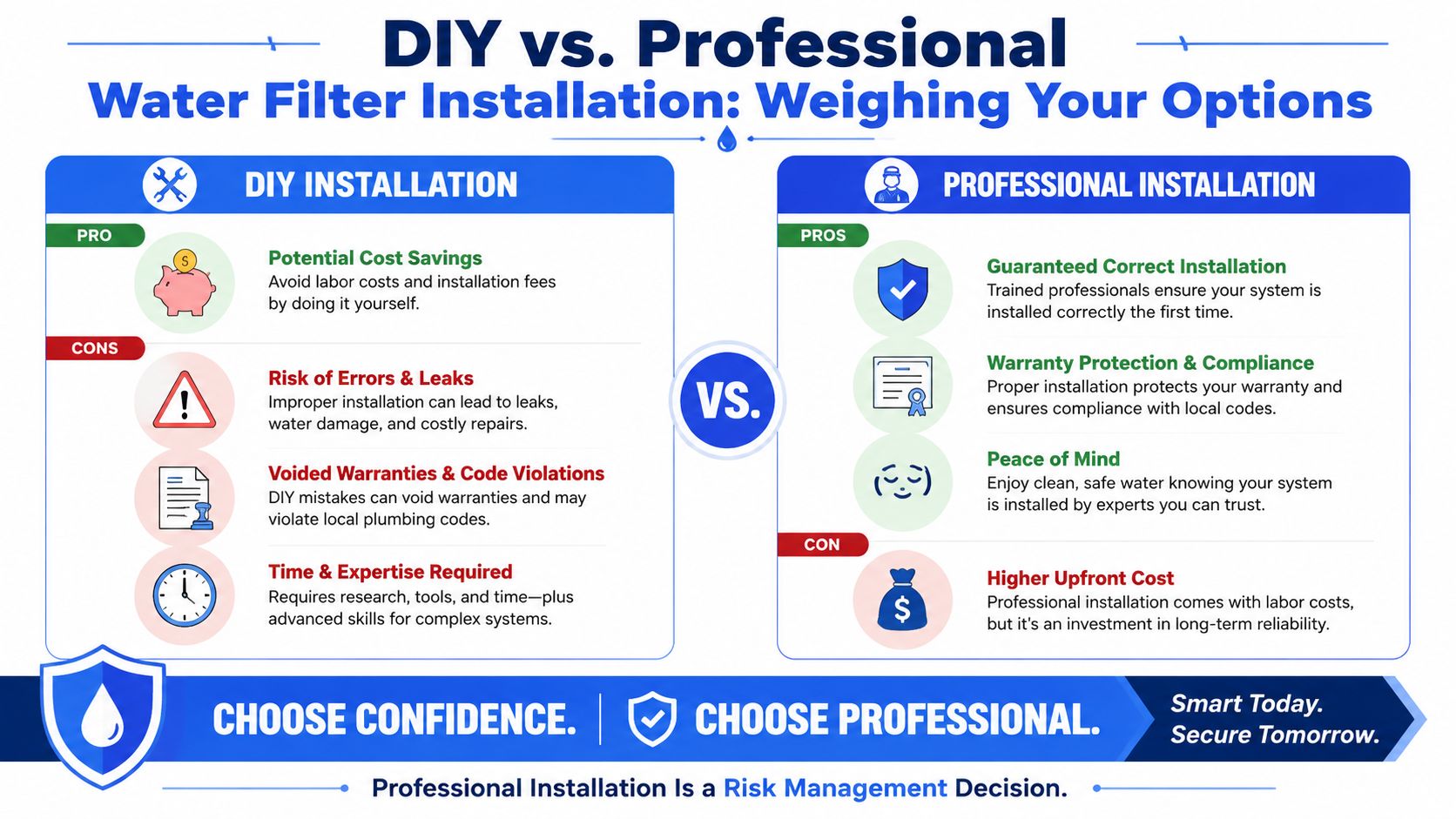
The appeal of DIY is obvious. A lot of under sink kits look simple. Push-fit fittings seem straightforward. Installation videos make it look like a quick Saturday job.
The problem is that most of those videos skip the parts that cause trouble in Melbourne homes.
Why DIY videos leave gaps
Many DIY guides for under-sink filters fail to address local factors in Melbourne's west, like water hardness affecting RO performance or how to maintain compliant cross-connection control, leaving homeowners at risk of voided warranties or non-compliant plumbing work, as noted in this discussion of under-sink installation gaps.
That gap matters most in older homes, renovated kitchens, and any property where the plumbing has been altered over time. A filter isn't just a box with cartridges. It becomes part of the plumbing system. Once it's connected, pressure, drainage, shut-off arrangement and backflow considerations all come into play.
What a licensed plumber checks that DIY often misses
A licensed plumber is looking at the risks behind the filter, not just the filter itself.
- Drainage for RO units: Wastewater must discharge correctly into sanitary plumbing. A bad connection can create compliance issues and future odour or siphoning problems.
- Cross-connection control: Filtered and unfiltered lines can't just be tied together any way that fits.
- Pressure protection: A system that isn't protected properly can stress housings, fittings and connected fixtures.
- Warranty conditions: Product warranties often depend on compliant installation and suitable operating conditions.
A water filter that leaks under a sink usually doesn't fail dramatically. It fails slowly, inside a cabinet, until the chipboard swells and the homeowner notices the smell.
DIY can still be reasonable for very limited maintenance tasks, such as changing cartridges on an existing correctly installed system. But first-time water filter installations are different. The money saved upfront can disappear quickly if the result is a leak, a rejected warranty claim, or a non-compliant connection discovered during a later renovation or sale.
If the job involves cutting into mains pipework, adding RO drainage, changing valves, or working around hot water and gas services nearby, professional installation is the safer decision.
Understanding Costs Maintenance Schedules and Warranties
Homeowners usually ask two sensible questions. What will it cost to install, and what will it cost to keep running? The second question matters more than people think.
Water filtration has moved into the category of routine home upkeep in this region. Between 2018 and 2023, plumbing firms in Victoria's western region saw a 40–50% year-on-year increase in jobs tied to adding or upgrading filtration, indicating that these systems are becoming a normal part of renovation and maintenance planning, according to this market report on home water filtration demand.
What you are really paying for
The installed price is only one part of the picture. You're also paying for correct sizing, access for servicing, suitable valves, proper pressure protection, and workmanship that doesn't create a hidden problem later.
Maintenance costs vary because the system type, water conditions and household usage all change the service interval. Some homes burn through cartridges faster because of local water quality. Others mainly need steady scheduled servicing and periodic cartridge replacement.
What tends to hold up well over time:
- Systems with clear service access: If cartridges are easy to change, maintenance is less likely to be skipped.
- Correctly sized prefiltration: A sediment stage can protect more expensive downstream media.
- Realistic service planning: Generic retail schedules often don't match actual local conditions.
What tends to go wrong:
- Cheap units with awkward placement: The unit may technically work, but nobody wants to service it.
- No allowance for pressure or shut-off control: Even basic maintenance becomes more disruptive.
- Assuming all warranties are automatic: They usually depend on proper installation and correct use.
Estimated Costs and Maintenance for Water Filter Systems in Melbourne
Because homes, brands and layouts vary, exact pricing should be quoted on site. The table below is qualitative on purpose. It shows where the costs usually sit, not a fixed retail tariff.
| System Type | Estimated Installed Cost (AUD) | Annual Maintenance Cost (AUD) | Maintenance Task |
|---|---|---|---|
| Under sink carbon filter | Lower than whole-house and RO systems in most homes | Ongoing cartridge replacement cost applies | Replace cartridges, inspect fittings, flush if required |
| Reverse osmosis system | Usually higher than basic under sink systems because of added components and drain setup | Membrane and filter servicing over time | Replace prefilters, service membrane stages, check drain connection |
| Whole house filtration system | Often the highest installed cost because it involves main-line plumbing work | Depends on cartridge size and service interval | Replace cartridges, inspect housing seals, test pressure control and valves |
If your filter installation is happening during a broader upgrade, it's worth checking how it interacts with your hot water system setup and replacement planning. That's where long-term value often gets decided.
Water Filter FAQs and Your Next Steps
A lot of questions come up after homeowners narrow down the system type. Usually they're not about theory. They're about living with the thing once it's installed.
Common questions from Melbourne west homeowners
Will a water filter reduce my water pressure?
It can if the system is undersized, the cartridges are too restrictive for the application, or the filters are overdue for replacement. A properly selected and installed system should keep pressure loss manageable for the job it's designed to do.
Can I take an under sink filter with me if I move?
Sometimes, yes. But it depends on how it was connected, whether a separate tap was installed, and whether removing it will leave plumbing modifications behind that need to be made good. It's possible in some cases, but it shouldn't be assumed.
Is RO always the best option?
No. RO is a strong option for high-purity drinking water, but it's not automatically the best fit for every household. If your issue is broader whole-home water quality, an RO unit at the kitchen sink won't solve what's happening in the showers, laundry or hot water system.
How do I know when a filter needs servicing?
The usual signs are a change in taste or odour, a drop in flow, visible scale or sediment issues returning, or reaching the scheduled service interval recommended for your setup. A good installation makes this easy to monitor.
The smart move is to choose a system that matches your actual problem, fits your plumbing properly, and can be serviced without hassle. That matters more than chasing the most expensive unit or the most aggressive marketing claims.
If you want clear advice on water filter installations in Caroline Springs, Taylors Hill, and Melbourne's western suburbs, contact Total Plumbing & Hot Water Systems. They can assess your home's plumbing layout, explain the practical filter options, and provide a compliant installation that suits your water quality, budget and long-term maintenance needs.